
Law and the Humanities Map to debut new features at the British Legal History Conference

This week the Mapping the Arts and Humanities team is bringing a freshly upgraded Law and the Humanities Map to the 27th British Legal History Conference, hosted by the University of Nottingham from 1-4 July 2026.
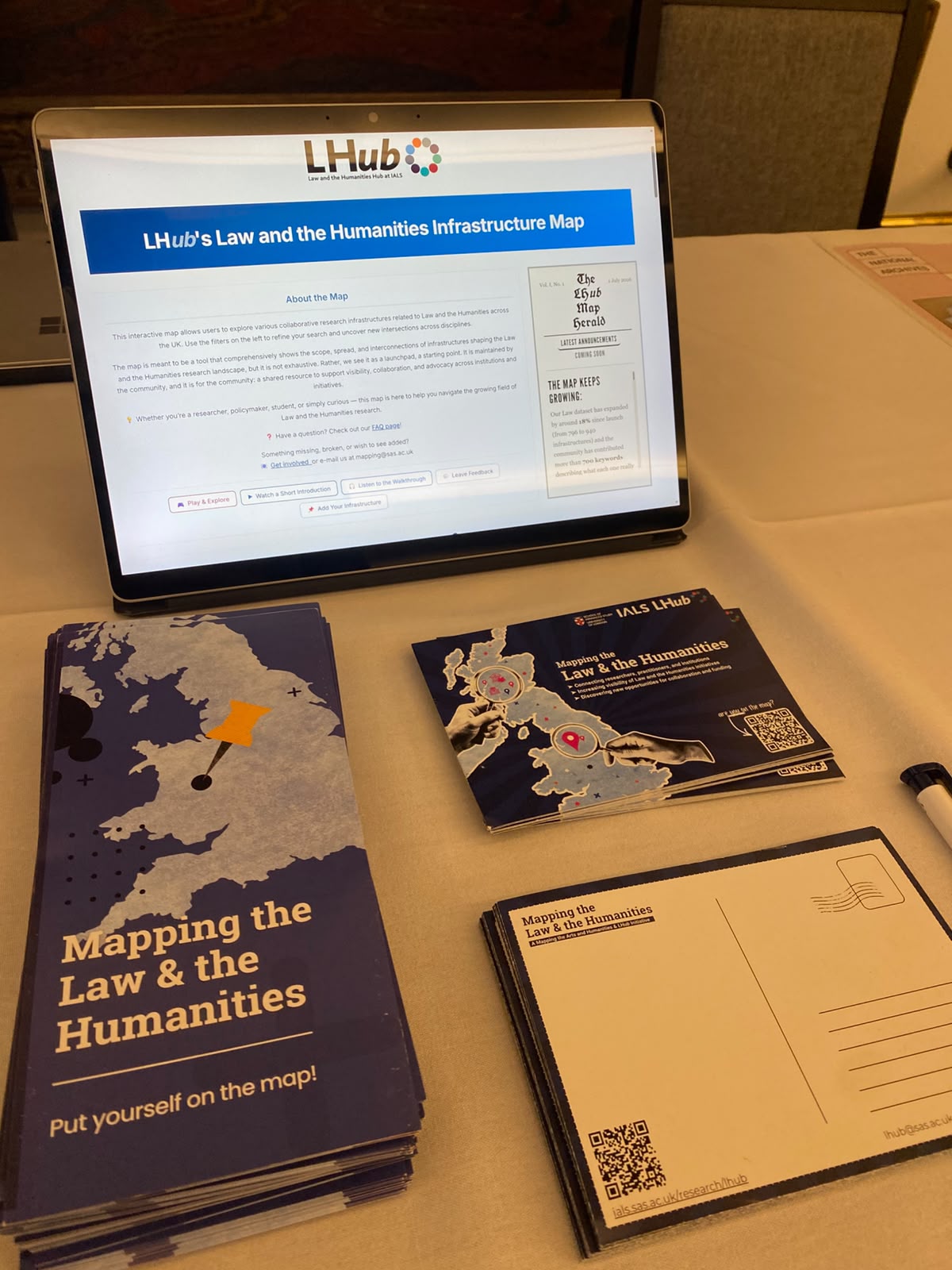 When we started the map a year ago, we were interested in seeing where law meets the humanities and who is doing that work. We designed it as an insight and partnership-building tool. A connector, if you like. One of its happiest accidents has been watching it connect people across borders and sectors, too.
We have also loved hearing all the new ideas that the community is coming up with. Among them, the need to record third-sector organisations and creative collectives who do vital research, or enable it alongside universities, but who might never call themselves a “research infrastructure.”
At its first outing in person (this spring, at the Socio-Legal Studies Association conference!) delegates from the UK and further afield used it to trace overlooked intersections and spark new partnerships. If you want to learn more, we’ve put together a short film of researchers and practitioners talking about what the map makes possible. If you would like to take a stroll down memory lane (it has been a year, after all), you can also read what the community told us in our focus groups, too.
And since we find ourselves among legal historians this week, it feels only right that the map has learned a little history of its own: every infrastructure on the map can tell you the year it was founded. Soon, you’ll even be able to watch the field take shape over time, sliding through the years to see how it has evolved.
Here’s what’s new.
New ways to explore the field
We’ve added several ways to slice the map so you can better explore what you’re interested in, giving you more control and greater precision over what you come across.
- A new Type filter lets you narrow the map to a single kind of infrastructure – show me only the Centres, or only the Networks.
- You can now filter by the keywords that infrastructures use to describe themselves, sitting alongside our curated Project Tags, with tidy, alphabetised labels so the list is easy to scan.
- A new results list lets you browse infrastructures as readable text instead of only clicking pins. A simple toggle filters the results into those on the map, those not yet on the map, and all of them together. This means that you can finally see the infrastructures that exist in the data but have no address on the record.
Clickable word clouds! Keywords!
As the dataset has grown, we’ve wanted to open up new ways into the map, and to deliver on the things the community asked us for. When we first introduced the map, you told us you’d like your own keywords to be visible across the platform. We’re happy to report that, now, they are.
In fact, did you notice how we slipped “keywords” into the section just above? If it left you scratching your head, here’s a quick refresher. Project tags are the shared, curated vocabulary we use to describe the field, partly based on the AHRC taxonomy; keywords are the free terms infrastructures choose for themselves. Back in 2025, we made keywords visible on the humanities.org.uk frontend and, for the first time, queryable through our public API. Now, you can explore and filter by them on the Law and the Humanities Map itself.
With that in mind, the map’s word clouds have been rebuilt accordingly from the ground up. There are now two tabs (Project Tags and Keywords) each split into the terms most associated with the field and the “potential gaps and opportunities”: the terms that crop up less often.
Best of all, every word is now clickable: choose a term and you’ll drill straight down to the exact infrastructures tagged with it, each linking out to its full page.
LHub director, Professor Anat Rosenberg, noted about the new features: “Keyword search allows for a nuanced filtering that follows researchers’ sensibilities, rather than more rigid disciplinary categories. It’s better tuned to changes in our interests and emerging topics. And of course, I am now consulting my colleagues on which keywords we should add to our own map entries.”
A growing map and the state of the field
This update also caps a year of change. The map has grown by around 18% (from 796 infrastructures to 940), much of it added by the community. But we don’t want to conflate a fuller record with real growth on the ground: most of those new entries are infrastructures that were already out there, now mapped for the first time, instead of brand-new arrivals.
It has been a hard year for UK higher education, and for the arts and humanities especially. Law has fared better than many of its neighbours: the British Academy’s report “Cold spots: Mapping inequality in SHAPE provision in UK higher education” (2025) found that, while modern languages and several other humanities subjects are losing regional provision, Law has actually expanded its reach since 2011/12, a resilience the Law and the Humanities Map reflects, too. But, as that same report cautions, “few subject areas are guaranteed resilient regional provision in the long-term.”
That is exactly why a map like this matters more, not less, right now: to show the field’s scale and reach, help people find one another, and make the case for work that can slip under the radar. More than four in five infrastructures (85%) in the Law subset are based within universities. When universities are squeezed, everyone feels it. This summer we are running our annual catching-up exercise (with a follow up in September): reaching out to hear directly from our communities about how they are doing, to confirm what is still running and what is not, and to take a more accurate measure of the year’s growth.
For all that, the field is still inventive. Its backbone shows in the most common Project Tags (Policy, Political Science, Human Rights, History, and Criminology) while this new year’s new entries point to where fresh energy is gathering:
- AI, data and rights – AI ethics and governance, algorithmic accountability, facial recognition, responsible AI, biometrics and digital rights.
- Climate and environmental justice – climate action, environmental justice, environmental law and climate litigation.
- Access to justice and criminal justice – the rule of law, civil liberties, policing and criminal justice reform.
- Inclusion and exclusion, participatory research, and arts and health — from anti-racism and disability justice to community-led research, applied theatre and arts in rehabilitation.
With more than 700 keywords now in use, the community is still actively naming new questions. The new word clouds put the field’s emerging vocabularies, and the questions behind them, at your fingertips.
Play & Explore: a new way in
The feature we’re most excited to debut is Play & Explore, a small hub of games that turn the map’s data into something you can play with.
- Daily Docket is a daily, guess-the-infrastructure puzzle in the spirit of Wordle. Each day, one real infrastructure becomes “the case.” It’s the same one for everyone, everywhere. You’re given up to five clues, drip-fed from hardest to easiest, and the goal is to name it in as few as you can. Solve it and the live map flies to the real pin, a verified “Did you know?” appears, and you can share a spoiler-free result grid with friends!
- Trivia is a quick five-question quiz, generated live from the data, so it never runs out and never goes stale.
- Just exploring is for the curious: one tap spotlights a real infrastructure you might never have come across.
- Research Journey, a more guided path we’re still refining is made with researchers in mind. You can choose a goal, a theme and an era, and the map matches you to real infrastructures working in your area.
James Campbell, one of the Law and the Humanities Map co-creators, noted: “What I like most about the new Play & Explore features is that they remind us that maps can be fun! They offer the community another way of exploring this complex and rapidly evolving research landscape. There is always more to discover!”
The map needs you!
If you’re at the British Legal History Conference this week, come and find us. We’d love to show you around, hear what you’d add, and put your work on the map.
📍Are you on the map? Check here. |🗺️ Explore the map | Add your infrastructure |📥Get in touch → mapping@sas.ac.uk
Elena Zolotariov is the Mapping the Arts and Humanities Liaison Officer.

Postcards from Nottingham III: Thinking about Infrastructure
Websites lapse, links break, and important history can slip through the digital cracks. Our third and final postcard from Nottingham steps back to think about the shapes research infrastructure takes: centres inside universities, a new network on a two-year pilot, learned societies run on subscriptions, and a charity that maps Britain’s towns from the ground up.

Postcards from Nottingham II: Digging into the Archives
Much of what we now call innovation began as grassroots practice. Our second postcard from...

Postcards from Nottingham I: the Law and the Humanities Map at the British Legal History Conference
What happens when you put an infrastructure map on a table for three days and ask people whether it has represented them accurately? The Law and the Humanities Map went to the 27th British Legal History Conference in Nottingham to find out.

The Law and the Humanities Map at the SLSA Conference 2026
The Law and the Humanities Map made its first in-person appearance at the Socio-Legal Studies...

Law and the Humanities in Practice: Voices from the Sector
Across universities and cultural institutions, there is a growing recognition that the discipline...

Law and the Humanities: A Disciplinary Cartography
James Campbell (Centre for Socio-Legal Studies, Oxford) joins us on the Mapping the Arts and...

Introducing LHub’s Law and the Humanities Map
This blog post shares key findings from recent focus groups on LHub’s Law and the Humanities Map....

LHub’s Law and the Humanities Map – FAQ
This FAQ is here to help you get the most out of the Law and the Humanities Map. It covers...

Launching Soon: Law and the Humanities Infrastructure Map
LHub and MAHP are launching a new open-access map dedicated to Law and Humanities research...
Join our mailing list
Receive blogs as soon as they're published, along with project updates and event information, plus special access to digital tools to help you make the most of the dataset.