
Infrastructure and innovation

💡As the UK’s arts and humanities infrastructure is mapped for the first time; Dr Jaideep Gupte considers how it will help to strengthen the UK’s global standing in the sector.
‘The ‘Mapping the Arts and Humanities’ project, which launched earlier this year, will produce an interactive map to allow users to find and connect with research activity more easily, and boost visibility for research centres and networks across the country.
Funded by the Arts and Humanities Research Council (AHRC) and Research England, this is the first time a full picture of the arts and humanities infrastructure across the UK will be built.
It is easy to assume the thriving research and innovation ecosystem we engage in today was always so.
Finding and supporting the best ideas
Finding, supporting, and scaling the best ideas (indeed knowing when to get out of the way of powerful ideas that can thrive on their own) so that these ideas can flourish in the future is more an art form, and less an output of a cookie-cutter equation with a few variables plugged in to punch out the final shape.
Without a guide to our past to know where we have come from, this art form becomes exponentially more difficult.
I would argue that without a knowledge of our past, innovation itself is left story-less, blind to the possibilities of the future. Ultimately, it is only the ideas that capture our imagination that drive us forward.
Long-term recommendations
In the mid-1990s, the bipartisan Dearing Inquiry Report set forth long-term recommendations on the purpose, size, shape, structure and funding of higher education.
The report endorsed a view of higher education as a private good, driven by fees and market regulation, rather than a social good.
In balance, the report also promoted a culture of life-long learning as a partnership between students, government and society. The establishment of AHRC was proposed as an important route to public funding of research.
Bold ambitions
As the policy landscape has evolved, so the arts and humanities research landscape has adapted and grown with it, responding to new opportunities and priorities and all the while growing our understanding of the world and what it means to be human.
AHRC’s ambitions are bigger and bolder than they have ever been. It is our view that we can strengthen brilliant arts and humanities research by shoring up and significantly enhancing the vital infrastructure that supports it to thrive.
Infrastructure programmes like research infrastructure for conservation and heritage science, convergent screen technologies and performance in realtime and infrastructure for digital innovation and curation in arts and humanities seek to address, at scale, fragmentation, silos and inefficiencies caused by ageing, suboptimal facilities.
They provide access and expertise to new and innovative technologies, and build networks to enable the collaborative approaches that are so critical to addressing contemporary challenges.
They also help realise immediate tangible benefits for cultural institutions, ensuring, for example, that our cultural heritage collections are cared-for, accessible and actively contributing to economic recovery and growth through the tourism and experience economy.
Pace of innovation
However, the pace of innovation necessitates a mapping, a guide, to ensure policy and strategic investments reflect ground realities.
Today the UK’s global standing in arts and humanities research is underpinned by a multifaceted network or ‘infrastructure’ of centres, groups and institutes that genuinely bring researchers together, explore new territory, and make novel connections across fields, sectors and communities.
This infrastructure is a vital driver of the sort of interdisciplinary thinking required in addressing today’s biggest challenges. And it provides fertile ground for the sort of discovery research that will lead us to the next big idea.
But it is often invisible, which means that it is hard for researchers to find one another, even harder for collaborators and policy makers to connect with research activity, and that we as funders are missing potential opportunities to support and nurture excellence.
Mapping the landscape for arts and humanities research today gives us the clearest indication of where we go next.
This blog was also published under the title ‘Mapping the Arts and Humanities‘ on the UKRI website.
Dr Jaideep Gupte is Director of Research, Strategy and Innovation at the Arts and Humanities Research Council.
In Development: Mapping the Humanities and AI
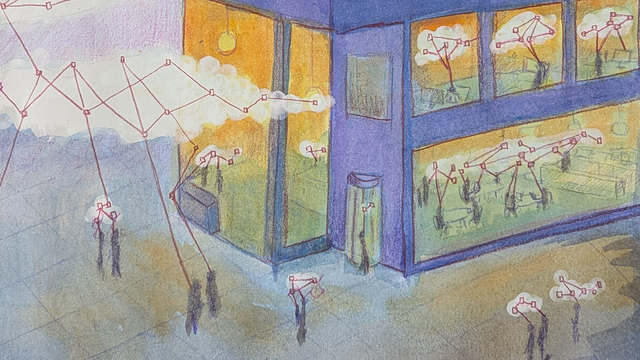
Humanities scholars across the UK are shaping critical thinking and practical action around AI. But the work is scattered across institutions and websites, which is making connections harder to spot. Mapping the Humanities and AI is a map in development that will visualise this activity, highlight networks and gaps, and support collaboration across research, policy, and practice.

Knowledge Diplomacy in Context: British Council, A Legacy of Building Connections
Michael Peak joins us for the "Knowledge Diplomacy in Context" series, which spotlights real-world...

Mapping Openness and AI: Insights from the AI and Openness Workshop for the Arts and Humanities (Part 1)
Sinem Görücü / Silicon Landscapes / Licenced by CC-BY 4.0Following the “AI and Openness” workshop,...

Knowledge Diplomacy in Context
International collaboration strengthens global ties, but the vital infrastructure behind it often...

UK DARIAH Day 2025: Imagining Future Digital Research Infrastructures
As the landscape of arts and humanities research becomes increasingly digitised, the necessity for...
Law and the Humanities in Practice: Voices from the Sector
Across universities and cultural institutions, there is a growing recognition that the discipline...

Introducing the Knowledge Diplomacy Mapping Initiative
The Knowledge Diplomacy Mapping Initiative (KDMI), a new collaboration from the Knowledge...

Law and the Humanities: A Disciplinary Cartography
James Campbell (Centre for Socio-Legal Studies, Oxford) joins us on the Mapping the Arts and...
Mapping Knowledge, Building Trust: A New Phase for the Knowledge Diplomacy Project
Dr Monja Stahlberger discusses the Knowledge Diplomacy Project's new phase, launching an...

Knowledge Diplomacy Mapping Initiative FAQ
This FAQ is here to help you get the most out of the Knowledge Diplomacy Mapping Initiative. It...
Tags
Join our mailing list
Receive blogs as soon as they’re published, along with project updates and event information, plus special access to digital tools to help you make the most of the dataset.