
Why Cardiff? Taking ScholarTHON to Wales
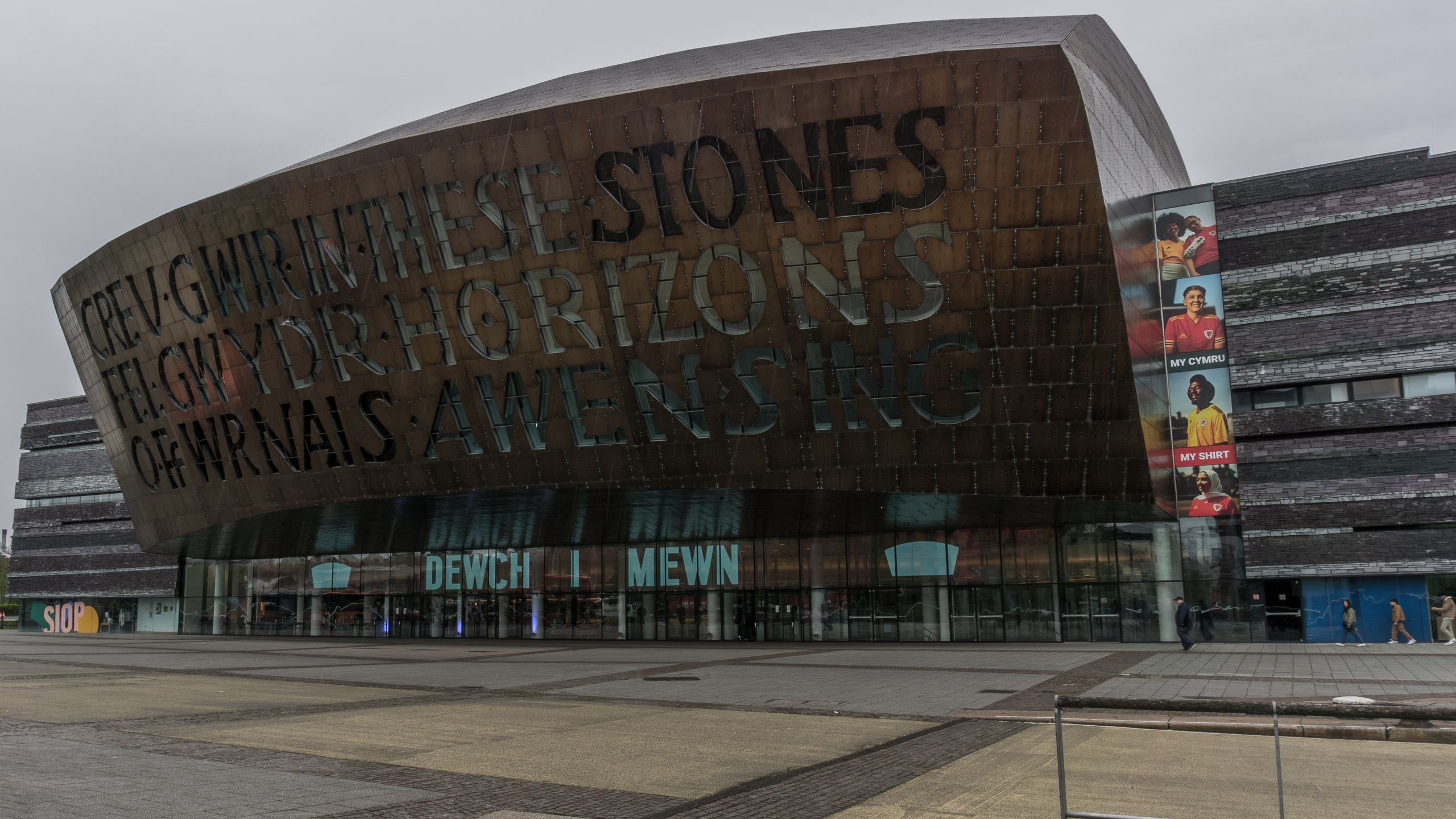
From the National Library of Wales to Bangor’s Language Technologies Unit, Wales holds a remarkable pool of expertise in organising knowledge. On 2 and 3 December 2026, the second ScholarTHON comes to Cardiff University, and we would love you to join us.
Last week we announced that the second ScholarTHON, “Organising Knowledge”, will take place at Cardiff University on 2 and 3 December 2026: two days that rethink the hackathon for arts and humanities research, with a Research Software Engineer at every table (you can read the full call here).
A roving ScholarTHON
More and more research events now travel and Wales has a rich culture of connecting researchers across regions and making events accessible to them. For example, the Learned Society of Wales holds its early career colloquium in a different part of Wales each year, from Swansea to Bangor to Aberystwyth, and offers “travel and accommodation bursaries to researchers travelling longer distances to attend our in-person events”.
As a national initiative, we want ScholarTHON to be within reach of researchers wherever they work or study in the UK. The first ScholarTHON caught people’s attention far beyond Oxford with participants from Coventry, Birmingham, and Durham, and sign-ups from across the country more broadly. It also attracted international interest. Even so, most of the room on the day came from Oxford and London, which reflects a wider pattern in where research money, and the opportunities that come with it, tends to gather in the UK, and in who can afford the time and travel to reach them.
According to UKRI’s official statistics, in 2023-24, UKRI invested £183 per person in London, the South East and the East of England, against £106 elsewhere in the UK and £53 in Wales. A 2022 review of doctoral training for AHRC also found placement opportunities scarcer “particularly outside London and the South-East,” and that the cost of travel to in-person activities was an issue for PhD students at some institutions.
Our own analysis of AHRC funding on Gateway to Research points the same way for Wales: its share of AHRC research grants and fellowships fell from 5.0% of awarded funds in 2006-10 to 2.6% in 2016-22, against 4.6% of the UK population, which comes to roughly half the per-person investment of London, the South East and the East of England over those years. This is why we want ScholarTHON to be a roving event, so that it can reach researchers and communities who might otherwise not be able to join us.
Why Wales?
Wales feels particularly apt for this theme because it holds a remarkable pool of expertise in the question this ScholarTHON explores, shaped in no small part by its bilingual context.
Welsh heritage is often described and catalogued in two languages, so decisions that can feel abstract elsewhere (whose terminology becomes the standard, how categories map from one language to another, how to record the many names and forms of the same thing) are daily practice for Welsh collections and infrastructures. To name just a few of the places where that expertise lives:
- The National Library of Wales, which appointed the UK’s first permanent Wikimedian in 2017, has linked the Welsh Language Commissioner’s list of standard place-names to Wikidata and to its own bilingual name-authority database, so that it can “capture place names in English and Welsh” and “record an unlimited number of variations or specify official spellings or historic spellings.”
- At Cardiff University, the Centre for Language and Communication Research led CorCenCC, the National Corpus of Contemporary Welsh: over 11 million words of written, spoken and online Welsh, built with Swansea, Lancaster and Bangor. The new Centre for Digital Humanities and Cultures Research, launched in 2025, brings five schools together with the University’s Special Collections and Archives.
- In Aberystwyth, the Department of Information Studies has trained the information profession for over 60 years, from librarianship to archives, records management and digital preservation. Nearby, the University of Wales Centre for Advanced Welsh and Celtic Studies produces Geiriadur Prifysgol Cymru, “the only standard historical dictionary of the Welsh language”, built from over two million citation slips and free online since 2014.
- At Bangor University, Canolfan Bedwyr’s Language Technologies Unit builds computational tools and resources for Welsh, from speech technology to electronic dictionaries, and publishes many of them openly.
- Swansea University’s Centre of Digital Arts and Humanities (CODAH) uses “innovative digital tools and methods for investigating different forms of text, data and media”, with projects across heritage, history, literature and linguistics.
- And the University of South Wales’s Hypermedia Research Unit works on knowledge organisation systems themselves (thesauri, gazetteers, ontologies). In 2013 it coordinated the project that made the Royal Commission’s heritage thesauri, alongside English and Scottish ones, freely available as linked open data.
As Dr Jenny Kidd (Reader in Digital Culture, Cardiff University) puts it:
We’re delighted to bring ScholarTHON to Cardiff University’s Centre for Digital Humanities and Cultures Research for two days of collaboration centred on how we organise and connect knowledge across the arts and humanities. We’re excited to welcome colleagues and explore new possibilities for how we work with knowledge and data.
Come along!
ScholarTHON is free and open to researchers at every career stage, to GLAM professionals and to Research Software Engineers, and no prior coding experience is required. You can find the two days, the Common Interests Lunch and the bursaries in our first post.
Register: Eventbrite | Questions: giovanna.dimartino@anthro.ox.ac.uk | 🗺️ Explore the map | 🔎 Explore the Data/Culture portal
Dr Elena Zolotariov is the Mapping the Arts and Humanities Liaison Officer at the School of Advanced Study, University of London.
Dr Giovanna Di Martino is Community and Project Manager for Data/Culture at Oxford, Honorary Leventis Fellow at UCL (2024-2027), and Fellow at Harvard’s Center for Hellenic Studies (2026-2027).

Learned Societies: English Association
The Mapping the Arts and Humanities project is bringing learned societies together, fostering collaboration, and amplifying the vital role of arts and humanities research. The English Association, alongside its partners, is working to support researchers, advocate for the subject, and champion the power of interdisciplinary connections in an evolving landscape. Elizabeth Fisher, Elizabeth Draper, and Jenny Richards share their vision and expertise in the area.

What is humanities research infrastructure?
Mapping the Arts and Humanities, a major project commissioned by the AHRC and Research England, is...

How do we capture the diversity of our research infrastructure?
Professor Jane Winters, Director of the Digital Humanities Research Hub at the School of Advanced Study, explores the challenges of identifying, classifying and quantifying our arts and humanities research landscape.

Infrastructure and innovation
💡As the UK’s arts and humanities infrastructure is mapped for the first time; Dr Jaideep Gupte considers how it will help to strengthen the UK’s global standing in the sector.
Join our mailing list
Receive blogs as soon as they're published, along with project updates and event information, plus special access to digital tools to help you make the most of the dataset.